Multidisciplinary Design
Every business challenge demands a custom strategy, and the path forward is rarely linear.
I combine customer empathy with data-backed validation to build frameworks that fit the actual market you are in. No rigid formulas. No templates. Just intentional work that moves fast because the thinking was done first.
03 / My Approach
Columbus, Ohio
My Philosophy on AI
I use AI for exploration, hypothesis testing, and getting to a rough prototype fast.
It’s a sandbox. When something moves toward production, I build it by hand, because tokens, component logic, and layout have to hold up under real use by real people. AI is very good at generating options: different styles, different layouts, more directions than anyone needs. It’s not good at knowing which one should ship. That call is mine, and it comes from years of learning which decisions hold up. Then I partner with engineering to get it in front of users.
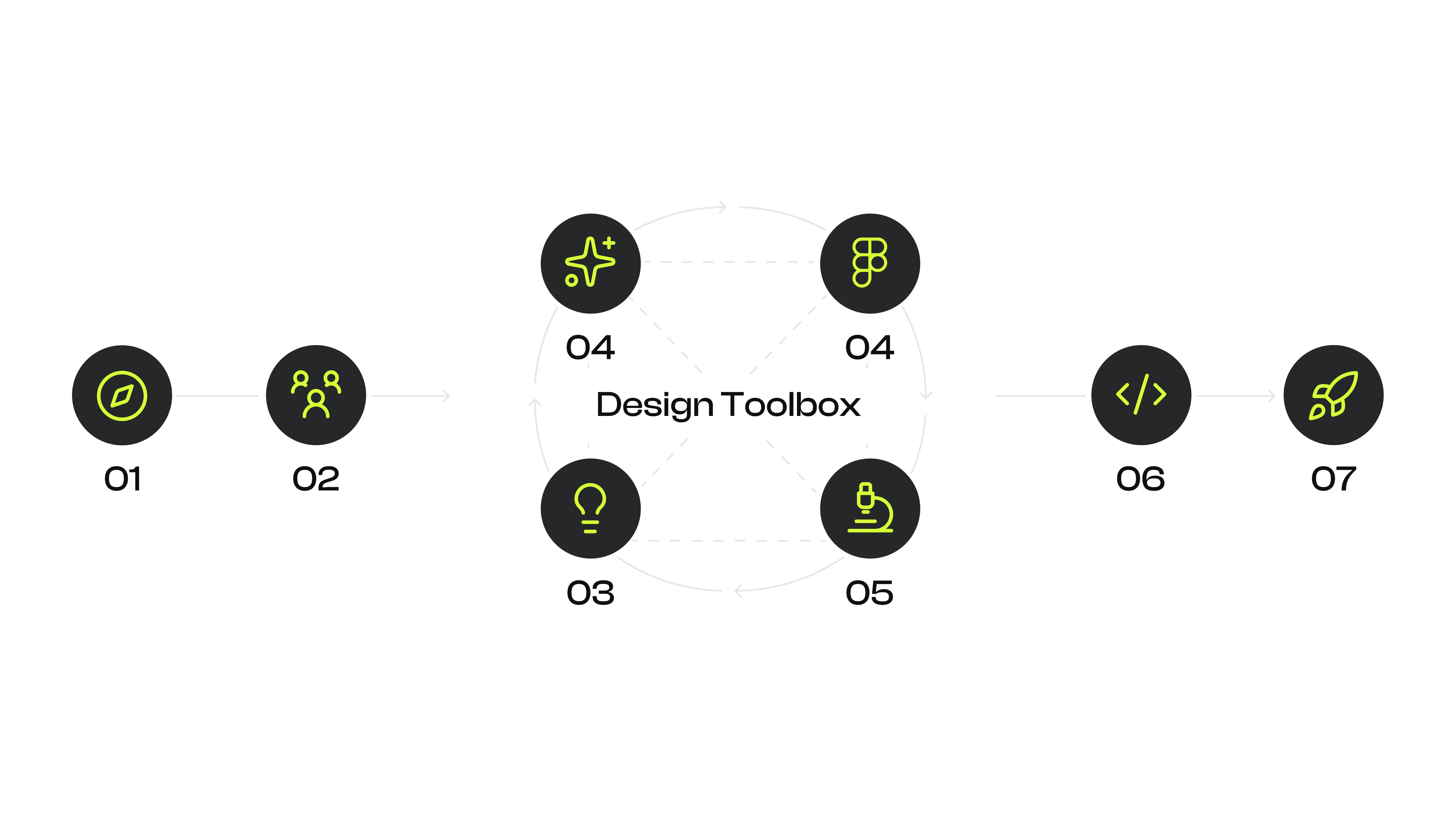
Here is how I bring that methodology to life
-
Step 1: Charting the Course
Before designing anything, I get clear on the objective. What is the actual problem, who is it for, and what does success look like. AI helps me synthesize constraints and sketch early frameworks quickly, so the team starts aligned instead of finding out in week three that we were not.
-
Step 2: Deep Dive
Real insight comes from talking to people. I run continuous research, interviews, and competitive analysis, then use LLMs to work through qualitative feedback at volume and surface patterns I would otherwise miss. The goal is strategy rooted in genuine frustration rather than assumption.
-
Step 3: Creative Exploration
This is where I push past the obvious answer. Tools like Claude Design, Figma Make, and Midjourney let me generate and compare a lot of directions fast. More options in less time means the good one is more likely to be in the pile.
-
Step 4: From Concept to Reality
I take the strongest ideas and build them into real flows and architectures. Core components get built by hand for structural precision, then I use Claude Code to scale that structure across alternative layouts. Testing variations instantly is how you find the best path rather than defending the first one.
-
Step 5: Hands-on Validation
Design is a conversation, not a handoff. I get concepts in front of users early to see what people actually do rather than what they say they would do. Claude Code lets me stand up functional prototypes overnight, so I can validate the risky assumptions before anyone commits engineering time to them.
-
Step 6: Engineering the Gap
I work closely with development to make sure what I design can be built. Pairing design system knowledge with Claude Code, I generate front-end prototypes to test implementation ideas early. AI handles the rough version. Production is deliberate engineering, every time. Speaking the same language as engineers removes an enormous amount of friction, and on one team it cut dev cycles by 25%.
-
Step 7: Launch & Beyond
Launch is the start. I track live data, optimize conversion, and keep the design infrastructure scaling as the product grows. AI stays in testing and iteration. The shipped product relies on human judgment.
Programs I use


Review my work to see how my process delivers real results.
My work